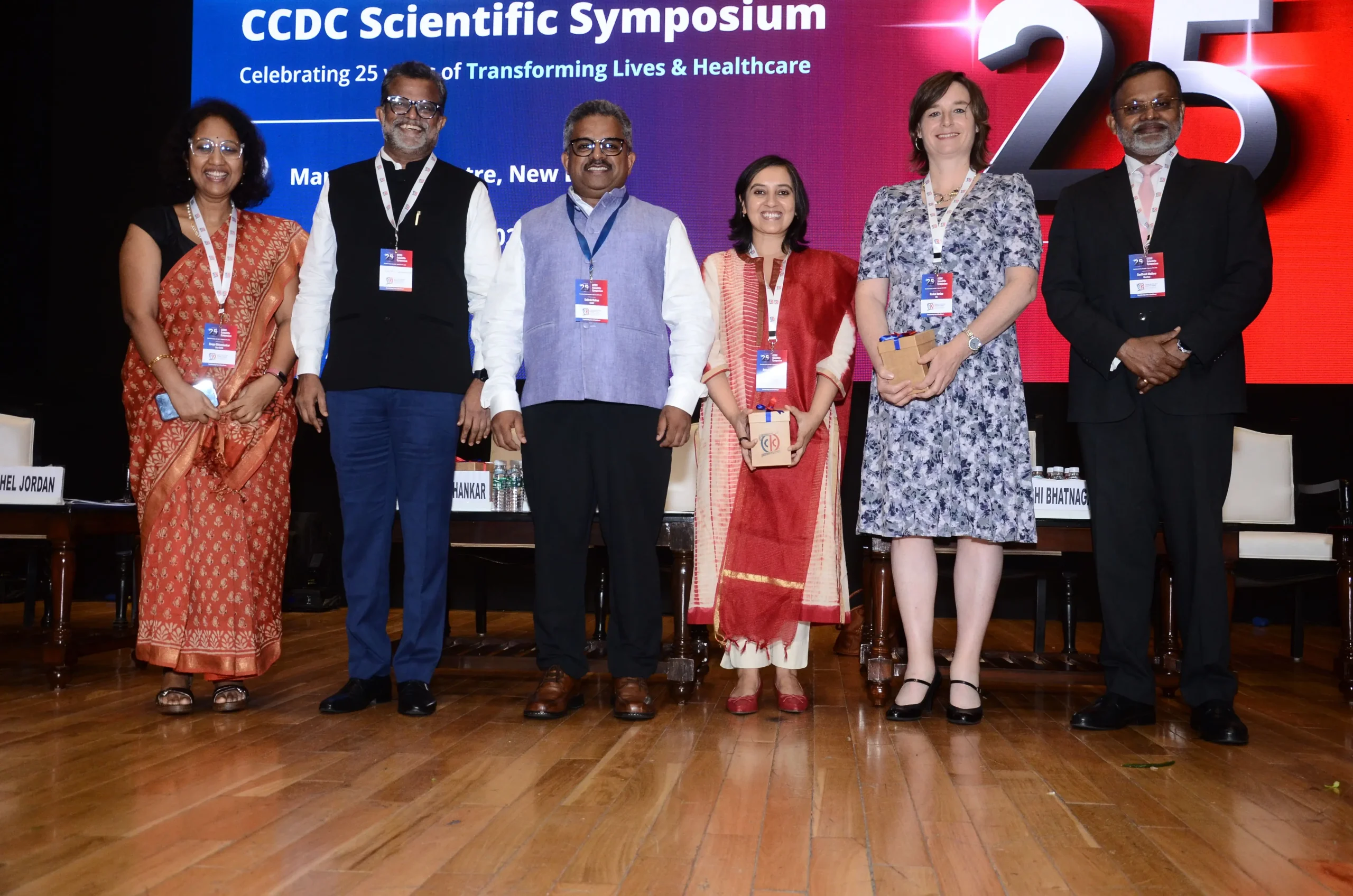
The research team at NIHR-GHRC for MLTC in India presented the centre’s work at the Centre for Chronic Disease Control (CCDC)’s research symposium.
In a panel discussion titled “Reimagining health systems for NCD care from research to practice”, the urgent need to strengthen India’s health systems was discussed. The panel addressed the rising tide of non-communicable diseases (NCDs), particularly hypertension and diabetes. The discussion was chaired by Prof. Sailesh Mohan, Deputy Director & Head, CVD Epidemiology, CCDC and Co-Chaired by Prof. Rachel Jordan, Professor of Epidemiology and Primary Care, University of Birmingham. Other speakers at the panel were: Dr Roopa Shivashankar, Senior Scientist at ICMR, Mr Rajeev Sadanandan, Health Systems and Policy Expert, Dr Aarushi Bhatnagar, Senior Economist, Health at the World Bank, Dr Santhosh Mathew, Deputy Director of State Systems & Partnerships at the Gates Foundation.
The session highlighted the paradox of rising disease burden despite system investments, and explored how evidence, innovation, and system redesign can be leveraged to deliver people-centred NCD care.
The NIHR Global Health Research Centre for Multiple Long-Term Conditions (MLTC) aims to make a meaningful difference in the lives of those experiencing MLTC. It is a five-year research-driven partnership between institutions in the United Kingdom, India and Nepal, funded by the National Institute for Health and Care Research (NIHR). The Centre is co-led by the Public Health Foundation of India and the University of Leicester in partnership with the All India Institute for Medical Sciences, Jodhpur; Health Related Information Dissemination Amongst Youth, New Delhi; Kathmandu Medical College, Nepal (co-applicant institutions) and other partners.
Despite its growing burden, MLTC have received minimal recognition from healthcare providers and policymakers. Health systems are still focused on individual disease management rather than having an integrated care model, resulting in the delivery of fragmented and inefficient care.
The Centre will strengthen research capacities and ecosystems of the co-applicant institutions and undertake extensive community engagement and involvement, and knowledge exchange interventions. This meaningful engagement with patients, caregivers, healthcare providers, communities, and relevant stakeholders at every stage of research will enhance ‘mutual learning’ to effectively address MLTC in both countries and beyond.