
Background
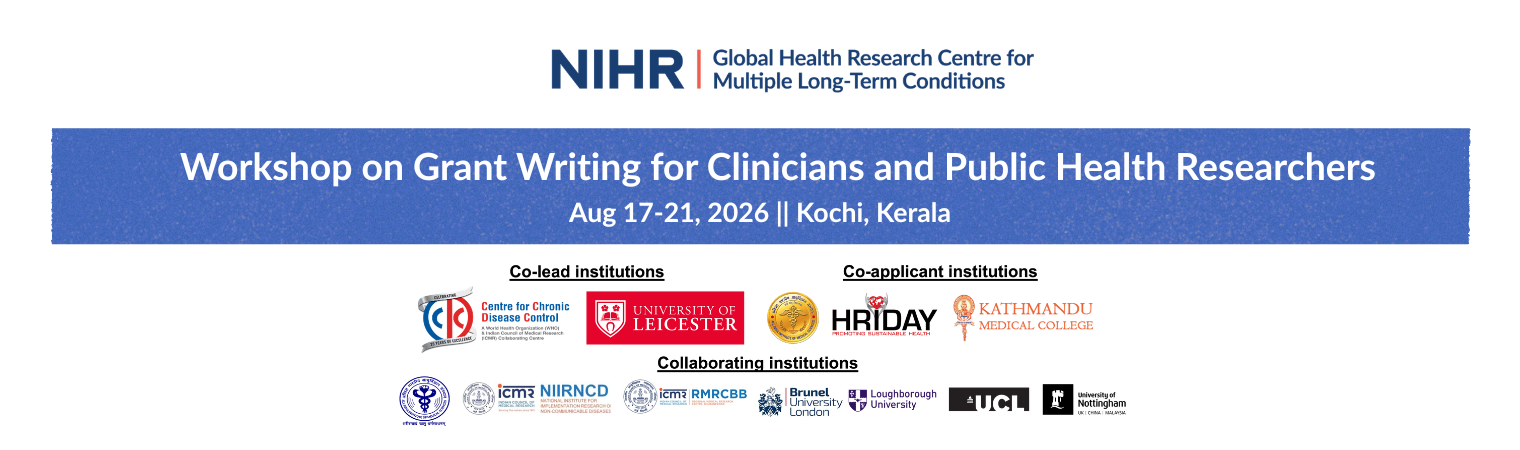
The Centre for Chronic Disease Control, LMIC co-lead organisation of the National Institute for Health and Care Research Global Health Research Centre for Multiple Long-Term Conditions is organising a workshop on grant writing for clinicians and public health researchers in Kochi, Kerala, from August 17-21, 2026. This workshop is part of the capacity-building endeavours under the ‘Research Capacity Strengthening’ work package of the Centre.
Grant writing is an essential skill for clinician-scientists and public health researchers who want to turn important yet unanswered research questions into funded projects. It is also important to build collaborations and sustain research activities to address priority clinical and public health research questions. In a milieu of intense competition for limited research funding, the following skills are crucial for clinicians and public health researchers:
(a) frame a clear clinical or public health problem;
(b) propose a rigorous and feasible methodology/approach;
(c) articulate clear and precise outcomes and impact and
(d) convincingly communicate all these within the word- or page-limit is essential.
About the workshop
This 5-day in-person workshop on grant writing will not only equip participants with the aforementioned skills but also provide an opportunity to seek guidance on their proposals from seasoned researchers with a track record of securing funding from national and international donors, as well as to interact with grantors and grantees. The workshop will comprise a mix of short lectures, practical exercises, small-group work, one-on-one mentoring sessions, and panel discussions with funders and grant recipients. Participants will also have dedicated time to work on their proposal and receive feedback.
Who should apply?
This workshop is designed for early- and mid-career clinician-scientists and public health researchers based in India who are interested in applying for grants to national or international funding agencies within the next 6-12 months. We particularly welcome applications from those who have not been successful in securing research funding in the past. We welcome applicants from diverse clinical and public health domains (non-communicable diseases, multiple long-term conditions, mental health, digital health, implementation science, maternal and child health, health systems, environmental health, etc.).
Key learnings & Outcomes
By the end of the workshop, participants will be able to
- Understand the grant funding landscape for clinical and public health research in India and globally
- Develop a clear problem statement
- Draft compelling, specific aims/objectives
- Design robust methods and implementation plans
- Prepare realistic budgets and work plans
- Address ethics, equity, and community engagement
- Receive individualised feedback on their draft proposal from experienced mentors
Develop a near-ready concept note or mini-proposal for a future grant call
Duration of the workshop
5 days (August 17-21, 2026)
Fee to attend the workshop:
The workshop is free of cost to attend for all participants. A limited number of bursaries are available to support travel to and/or stay in Kochi.
How to apply?
Interested candidates should apply through this link before 5.00 PM on June 30, 2026. Please upload a single PDF named “Grant_writing_workshop_your full name” containing the following:
a) 2-page CV
b) Statement of interest in attending the workshop (one-page max)
c) Concept note on the future grant application (one-page max) and
d) Support letter from the head of the institution or organisation (see the REDCap link above for the template)
In case you have queries or questions, please email nihrcentre@ccdcindia.org