
About the short course
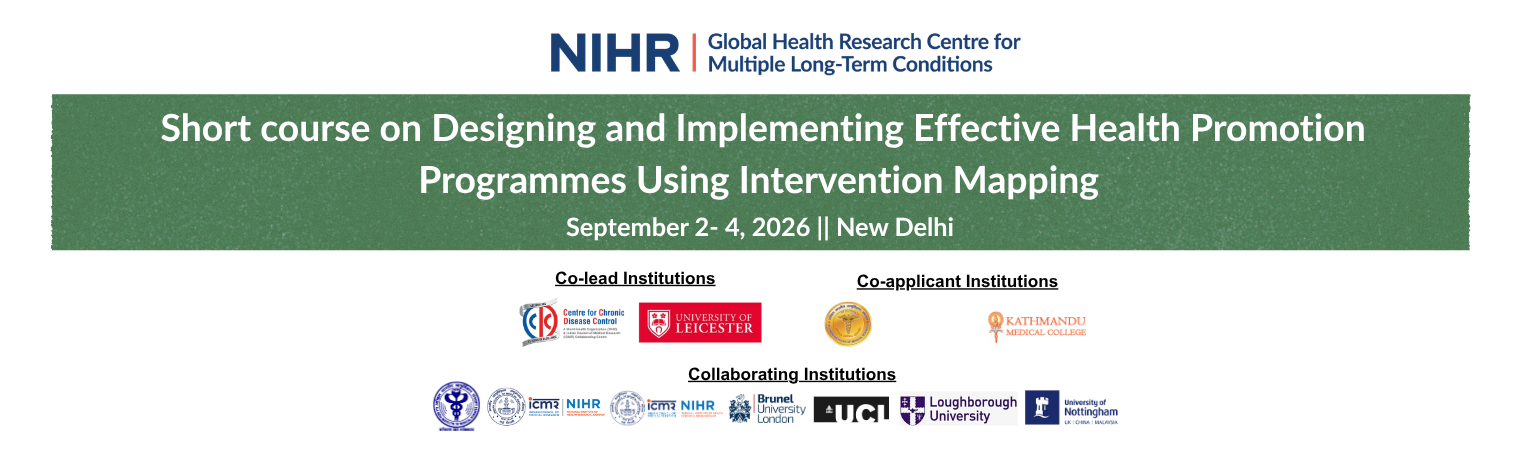
This 3-day in-person intensive short course aims to equip participants with knowledge and practical skills in Intervention Mapping, a systematic framework for developing theory- and evidence-based health promotion programmes. Through lectures and group activities, participants will learn how to conduct needs assessments, develop intervention strategies, plan implementation and design evaluation frameworks for health promotion programmes.
Short course format
The course encompasses lectures, group work sessions and participant presentations. During the group work sessions, groups will select a relevant public health scenario and begin using Intervention Mapping to design a health promotion programme.
What will you gain by attending this short course?
By the end of the short course, participants will be able to:
- Learn to use ‘Intervention Mapping’, a framework for systematically developing health promotion programmes using theory, evidence and a well-defined process.
- Carry out a needs assessment to develop a health promotion programme in a structured way in low- and middle- income country settings.
- Implement and evaluate the health promotion programme.
Who should apply?
The course is aimed at clinical and public health researchers with postgraduate-level training and prior experience in intervention development or evaluation.
Fee to attend the workshop:
The workshop is free for all participants. A limited number of bursaries are available to support travel to and stay in New Delhi.
How to apply?
Interested candidates should apply by July 25, 2026, before 5 PM IST, along with the documents below in a single PDF;
- a) 2-page CV
b) Statement of interest in attending the course (1 page maximum)
c) Brief description of a current or planned project/programme where Intervention Mapping could potentially be applied (1 page maximum)
d) Institutional support letter (if applicable) from the head of the institution or organisation
In case you have any queries or questions, please email nihrcentre@ccdcindia.org.